
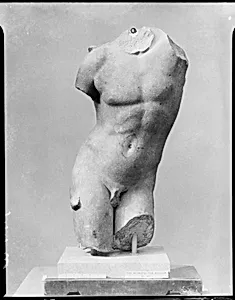
Marble torso of Eros
1st or 2nd century CE
Medium
Marble
Dimensions
H. 30 5/8 in. (77.8 cm)
Classification
Stone Sculpture
Culture & Period
Roman · Imperial
Department
Greek and Roman Art
Museum
Metropolitan Museum of Art, New York, NY
Credit
Fletcher Fund, 1924
Accession Number
24.97.14
Rights
Public Domain
Tags
Art Historical Context
This exquisite marble torso of Eros, to the renowned 4th-century BCE Greek Praxiteles, dates to the 1st or 2nd century CE exemplifies Roman Imperial artistry. Likely a copy of a lost Hellenistic original, it captures the god of love—known to Romans as Cupid—in a dynamic, sensual pose, with gracefully twisting hips and taut musculature that evoke Praxiteles' signature style soft, naturalistic forms. Standing at 30 5/8 inches tall, the fragment highlights the master's influence on later generations, as Romans avidly reproduced Greek masterpieces to adorn villas and public spaces. Carved from fine white marble, the torso showcases advanced Classical techniques: subtle surface polishing for a luminous sheen, anatomical precision in the abdomen and shoulders, and a sense of restrained movement that suggests Eros in mid-flight or embrace. Such sculptures were prized in elite Roman society for their erotic appeal and divine beauty, blending Greek idealism with Imperial realism. Acquired through the Fletcher Fund in 1924, this piece from the Metropolitan Museum of Art's Greek and Roman collection invites us to ponder Eros' timeless allure—eternal love rendered in stone, bridging ancient worlds to our own.
About the Artist
Praxiteles
Praxiteles (flourished 370–330 BCE) stands as one of the most original and influential sculptors of ancient Greece, whose revolutionary approach to the human form profoundly altered the course of Western sculpture. Active during the fourth century BCE in Athens, Praxiteles transformed the detached, majestic style of earlier Greek sculpture into one of gentle grace and sensuous charm, introducing a...