
Maria
1516
Medium
engraving
Dimensions
118; 74
Rights
Public Domain
About this artwork
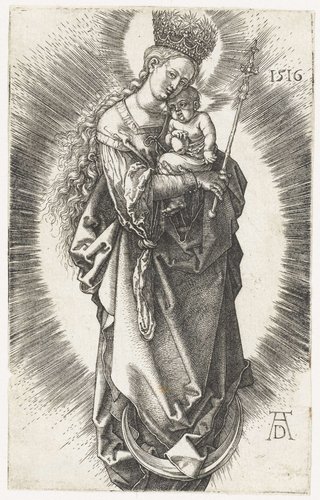
Maria met lang krullend haar en een sterrenkroon op het hoofd, staand op een maansikkel, omgeven door een stralenkrans, het Christuskind op de linkerarm, een scepter in de rechterhand.
Art Historical Context
Albrecht Dürer's *Maria* (1516) is a exquisite small-scale engraving, measuring just 118 mm by 74 mm, exemplifying the Northern Renaissance master's unparalleled skill in printmaking. Created during the late phase of Dürer's career, this work captures the profound religious devotion of early 16th-century Europe, on the cusp of the Reformation. Dürer, a German artist renowned for blending meticulous observation with symbolic depth, elevated engraving from mere reproduction to high art, allowing intricate details to reach a wide audience beyond wealthy patrons. The image depicts the Virgin Mary in a classic iconographic pose drawn from the Book of Revelation: standing triumphantly on a crescent moon, crowned with stars, and enveloped in a radiant halo of rays. Her long, curly hair flows freely, while she cradles the Christ Child on her left arm and holds a scepter of authority in her right. This "Woman of the Apocalypse" symbolizes Mary's role as Queen of Heaven, protector against evil, and intercessor—imagery that resonated deeply in Catholic worship and popular piety. Dürer's technique shines in the fine, burin-cut lines that render textures from Mary's flowing locks to the ethereal glow of the halo, creating depth and luminosity on a tiny copper plate. Such engravings were prized for private meditation, bridging art and spirituality in an era of religious fervor. A testament to Dürer's innovation, *Maria* invites viewers to ponder divine grace in intimate scale.
About the Artist
Albrecht Dürer · 1471–1528
Albrecht Dürer (1471–1528) stands as the preeminent figure of the Northern Renaissance and arguably the most influential artist in the history of printmaking. Born in Nuremberg on May 21, 1471, and dying in the same city on April 6, 1528, Dürer revolutionized the status of the artist in Northern Europe, transforming printmaking from a commercial craft into an independent fine art and establishing ...