
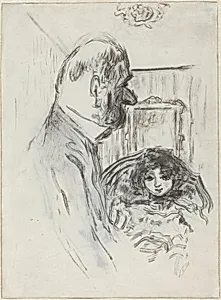
Marie and Her Protector [recto]
1897
Medium
brush and black ink
Dimensions
overall: 21.3 x 15.7 cm (8 3/8 x 6 3/16 in.)
Classification
Drawing
Department
CG-E
Museum
National Gallery of Art, Washington, D.C.
Credit
Virginia and Ira Jackson Collection
Accession Number
2001.136.22.a
Rights
Public Domain
Art Historical Context
Pierre Bonnard's *Marie and Her Protector [recto]*, created in 1897, is a delicate and black ink drawing measuring 21.3 x 15.7 cm, now housed in the National Gallery of Art's Virginia and Ira Jackson. At just over eight by six inches, this intimate work exemplifies Bonnard's early mastery of line during his formative years in fin-de-siècle Paris, when he was aligning with the avant-garde Les Nabis group alongside peers like Maurice Denis and Édouard Vuillard. As a Post-Impressionist innovator, Bonnard favored fluid, expressive brushwork to evoke emotion and domestic warmth, often drawing from everyday life. Here, the title hints at a tender relationship—possibly between a figure named Marie and a guardian companion—rendered with economical strokes that prioritize suggestion over photorealism. The use of brush and black ink, rather than pencil, underscores the Nabis' emphasis on decorative line and pattern, bridging drawing and painting in Bonnard's oeuvre. This modest-scale piece, classified as a drawing in the CG-E department, reveals the artist's preparatory mindset before his celebrated color-drenched canvases. It invites visitors to appreciate Bonnard's subtle draftsmanship, a cornerstone of his enduring legacy in capturing fleeting, personal moments.
About the Artist
Pierre Bonnard · 1867–1947
Pierre Bonnard (1867–1947) was a French painter and printmaker who became a leading figure in the Post-Impressionist movement and a founding member of Les Nabis. Born on October 3, 1867, in Fontenay-aux-Roses, France, Bonnard initially studied law at his father's insistence, graduating and briefly practicing as a barrister in 1888. However, his true passion lay in art, and he had simultaneously at...