
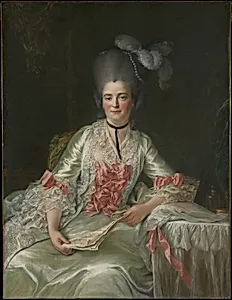
Marie Rinteau, called Mademoiselle de Verrières
Medium
Oil on canvas
Dimensions
45 1/2 x 34 5/8 in. (115.6 x 87.9 cm)
Classification
Paintings
Department
European Paintings
Museum
Metropolitan Museum of Art, New York, NY
Credit
The Jules Bache Collection, 1949
Accession Number
49.7.47
Rights
Public Domain
Tags
Art Historical Context
François Hubert Drouais's *Marie Rinteau, calledademoiselle de Verrières* (1761) is a oil-on-canvas portrait that exemplifies the elegance of mid-18th-century French. Measuring an impressive 45½ x34⅝ inches, this work captures the sitter—a woman likely from the fashionable circles of Louis XV's court—in a style that blends Rococo refinement with emerging neoclassical poise. Drouais, a leading portraitist of his era and son of the painter Hubert Drouais, was renowned for his ability to convey social status through luxurious fabrics, subtle expressions, and masterful rendering of skin tones and lace details. Created during the lavish final decades of the Ancien Régime, the painting reflects the cultural obsession with portraiture among the aristocracy and intelligentsia. Oil on canvas allowed Drouais to achieve luminous effects and intricate textures, techniques that elevated his works to the salons of Versailles. Mademoiselle de Verrières, whose epithet suggests a theatrical or social persona, embodies the era's blend of beauty, wit, and intrigue. Today, this gem from The Jules Bache Collection graces the Metropolitan Museum of Art's European Paintings department, offering visitors a window into the opulent world before the French Revolution. It's a testament to Drouais's skill in immortalizing the fleeting glamour of 18th-century high society.
About the Artist
François Hubert Drouais · 1727–1775
He was a fashionable portraitist. He is best known for portraits of children and one of Mme de Pompadour from 1763, completed after her death. Comment on works: Portraits