
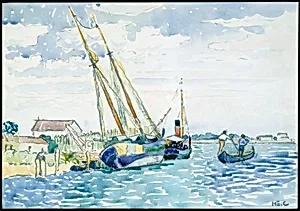
Marine Scene (Boats near Venice)
Medium
Watercolor over graphite on white wove paper dry-mounted on heavy wove card
Dimensions
6 3/4 x 9 11/16 in. (17.1 x 24.6 cm)
Classification
Drawings
Department
Robert Lehman Collection
Museum
Metropolitan Museum of Art, New York, NY
Credit
Robert Lehman Collection, 1975
Accession Number
1975.1.593
Rights
Public Domain
Tags
About this artwork
This luminous watercolor depicts sailing vessels on the water near Venice, rendered with the distinctive color harmonies and simplified forms characteristic of Neo-Impressionism. Cross captures the shimmering effects of light on water through carefully modulated washes of color, creating an atmospheric scene that balances observation with decorative sensibility. The composition emphasizes horizontal bands of sky, water, and distant architecture, with the boats providing vertical accents that ani...
Art Historical Context
Henri-Edmond Cross's *Marine Scene (Boats near Venice)* (1903) captures the shimmering beauty of Venice's lagoon with sailing vessels gliding across luminous waters. This delicate watercolor over graphite on white wove paper masterfully employs translucent washes to evoke the play of light on the sea, sky, and distant architecture. Horizontal bands of color create a serene, atmospheric harmony, while the boats add dynamic vertical accents, blending precise observation with Neo-Impressionist simplification. A key figure in the evolution of Neo-Impressionism, Cross (1856–1910), born Henri-Edmond-Joseph Delacroix, shifted in his later years from Seurat's rigid divisionism to a more fluid, expressive style. Created during a Venetian trip, this work reflects his fascination with the city's unique light, marking his mature phase of bold color and decorative sensibility. Housed in the Metropolitan Museum of Art's Robert Lehman Collection, the piece highlights Cross's influence on modern art, inspiring Henri Matisse and Fauvism through its liberated approach to color and form. Visitors will appreciate how it bridges scientific precision with intuitive modernism, inviting a sense of tranquil wonder.