
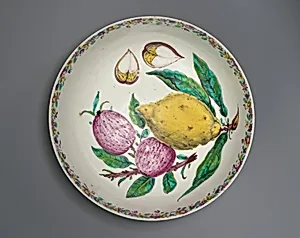
Marriage bowl
Medium
Soft-paste porcelain
Dimensions
3 1/4 × 8 13/16 in. (8.3 × 22.4 cm)
Classification
Ceramics-Porcelain
Culture
British, Bow, London
Department
European Sculpture and Decorative Arts
Museum
Metropolitan Museum of Art, New York, NY
Credit
Gift of Irwin Untermyer, 1964
Accession Number
64.101.731
Rights
Public Domain
Tags
Art Historical Context
This elegant marriage bowl, crafted in 1761 by the Bow Porcelain Factory in London, exemplifies the refined domestic wares produced during Britain’s early porcelain boom. Made of soft-paste porcelain—a material developed by European factories to mimic the translucency of prized Chinese hard-paste—the piece measures just over eight inches across, suggesting it served as a decorative or ceremonial vessel rather than everyday tableware. Its modest size and graceful form reflect the factory’s focus on accessible luxury for middle- and upper-class households. The bowl’s painted decoration of lemons and other fruit hints at themes of fertility and prosperity, fitting for a marriage gift. Bow’s painters often drew from natural motifs, applying delicate overglaze enamels that brought warmth and color to the creamy white body. As one of England’s pioneering porcelain manufacturers, Bow helped establish a distinctly British aesthetic that blended Rococo lightness with practical charm. Acquired by the Metropolitan Museum of Art as a gift in 1964, this object offers visitors a tangible connection to Georgian-era celebrations and the technical ingenuity of 18th-century ceramic innovation.
About the Artist
Bow Porcelain Factory · 1747–1776
The Bow Porcelain Factory, established around 1747 in East London near Bow and relocated by 1749 to "New Canton" east of the River Lea, emerged as one of England's pioneering soft-paste porcelain manufacturers, rivaling the Chelsea factory. Founded by merchant Edward Heylyn and Irish painter Thomas Frye, who secured key patents in 1744 and 1748–49 for using Cherokee kaolin and bone ash, the factor...