
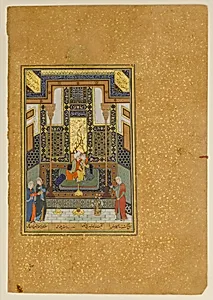
"Marriage of Khusrau and Shirin", Folio 104 from a Khamsa (Quintet) of Nizami of Ganja
dated A.H. 931/1524–25 CE
Medium
Ink, opaque watercolor, and gold on paper
Dimensions
Painting: H. 7 in. (17.8 cm) W. 4 3/4 in. (12.1 cm) Page: H. 12 5/8 in. (32.1 cm) W. 8 3/4 in. (22.2 cm) Mat: H. 19 1/4 in. (48.9 cm) W. 14 1/4 in. (36.2 cm)
Classification
Codices
Department
Islamic Art
Museum
Metropolitan Museum of Art, New York, NY
Credit
Gift of Alexander Smith Cochran, 1913
Accession Number
13.228.7.6
Rights
Public Domain
Tags
Art Historical Context
This exquisite folio from a 1524–25 Persian manuscript of Nizami Ganjavi’s Khamsa captures the joyful marriage of the Sasanian prince Khusrau and the Armenian princess Shirin, a beloved episode from one of the most celebrated romantic epics in Persian literature. Created during the early Safavid period, the painting reflects the era’s refined courtly culture, where poetry, storytelling, and visual art intertwined to celebrate themes of love, devotion, and royal union. Executed in ink, opaque watercolor, and gold on paper, the work exemplifies the collaborative nature of Persian manuscript production. Multiple artists—Sultan Muhammad Nur, Mahmud Muzahib, and Shaikh Zada—likely contributed to its delicate figures, intricate architectural details, and luminous gold accents. Such techniques allowed for rich narrative scenes within a compact format, designed to be viewed intimately as pages were turned during recitations. Housed in the Metropolitan Museum of Art’s Islamic Art collection, this folio highlights the enduring cultural importance of Nizami’s verses, which inspired generations of painters to visualize timeless tales of passion and partnership for royal patrons and later audiences alike.