
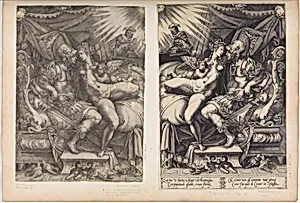
Mars and Venus
Medium
Engraving
Classification
Prints
Department
Drawings and Prints
Museum
Metropolitan Museum of Art, New York, NY
Credit
Harris Brisbane Dick Fund, 1927
Accession Number
27.78.2(180)
Rights
Public Domain
Tags
Art Historical Context
In the bustling world of 16th-century Italian printmaking, *Mars and Venus* (1543), an exquisite engraving attributed to Enea Vico or Giovanni Battista Scultori captures the timeless allure of classical mythology. Vico, a prolific Mannerist engraver from Parma, and Scultori, a Mantuan master known for his reproductive prints, both excelled in translating paintings into intricate prints. This work, housed in the Metropolitan Museum of Art's Drawings and Prints department, the era's technical prowess in engraving—a labor-intensive intaglio process where metal plates are incised with a burin to create fine lines, allowing for rich tonal depth and widespread dissemination of images. The scene depicts the illicit love affair between Mars, the god of war (symbolized by swords), and Venus, goddess of love, with Cupid nearby and birds adding a naturalistic touch. Likely inspired by Ovid's *Metamorphoses* and earlier paintings by artists like Sandro Botticelli, it reflects Renaissance fascination with pagan myths as metaphors for human passion and vulnerability. Such engravings were prized collector's items, bridging elite art with broader audiences. This Harris Brisbane Dick Fund acquisition highlights engraving's role in the print revolution, making high art accessible and fueling the cultural revival of antiquity during the 1540s. A delightful window into Renaissance romance! (198 words)
About the Artist
Enea Vico|Giovanni Battista Scultori · 1523–1567
Enea Vico (1523–1567) was born in Parma and came of age during the final, energetic decades of Italian Renaissance printmaking. By 1541 he had made his way to Rome, where he entered the orbit of the engraver and publisher Tommaso Barlacchi and began his professional career. In Rome, Vico encountered the work of the most celebrated printmakers of the preceding generation—Marcantonio Raimondi, Agost...