
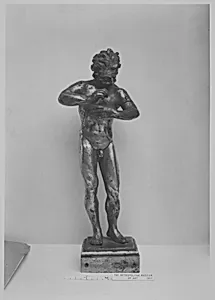
Marsyas Playing the (missing) Double Flute
Unknown Artist
late 16th century
Medium
Gilt bronze
Dimensions
Height: 11 1/8 in. (28.3 cm)
Classification
Sculpture-Bronze
Culture
probably German
Department
European Sculpture and Decorative Arts
Museum
Metropolitan Museum of Art, New York, NY
Credit
Bequest of Michael Dreicer, 1921
Accession Number
22.60.36
Rights
Public Domain
Tags
Art Historical Context
This exquisite gilt bronze sculpture, *Marsyas Playing the (missing) Double Flute*, a dramatic moment from Greek mythology. Marsyas, a satyr known for his musical prowess, is depicted in a dynamic pose, passionately blowing into the double aulos—or flute—that he famously discovered after Athena discarded it. The flute's absence in this late 16th-century work adds an intriguing layer of incompleteness, perhaps emphasizing the myth's tragic arc, where Marsyas's hubris leads to his flaying by Apollo. Standing just over 11 inches tall, the nude male figure exemplifies Renaissance ideals of anatomical precision and expressive movement. Crafted in gilt bronze—a luxurious medium combining cast bronze with a thin gold overlay—this small-scale sculpture likely served as a collector's item or table ornament in elite European households. The gilding not only enhances its opulent sheen but also evokes the divine glow of classical gods, bridging ancient lore with Mannerist tendencies of the period. Attributed to a probably German workshop, it reflects Northern Europe's fascination with Greco-Roman themes during the late Renaissance, blending technical virtuosity in bronze casting with a sensual celebration of the male form. Housed in the Metropolitan Museum of Art's Department of European Sculpture and Decorative Arts, this piece entered the collection through the 1921 bequest of Michael Dreicer. It invites visitors to ponder the interplay of music, myth, and mortality in art that still resonates today.