
Martha Round Caldwell
1798-1803
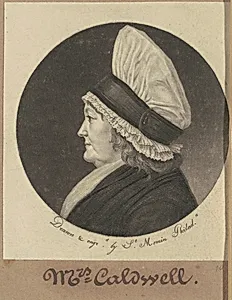
Medium
mezzotint and engraving in black on wove paper mounted to brown wove paper
Dimensions
image (irregular): 5.56 × 5.56 cm (2 3/16 × 2 3/16 in.) sheet (trimmed to plate): 6.67 × 6.19 cm (2 5/8 × 2 7/16 in.)
Classification
Department
CG-W
Museum
National Gallery of Art, Washington, D.C.
Credit
Corcoran Collection (Gift of William Wilson Corcoran)
Accession Number
2015.19.1584.10.5
Rights
Public Domain
Art Historical Context
**Martha Round Caldwell** (1798–1803) by Charles B. J Févret de Saintémin captures the refined likeness of a woman in the young American republic. Saint-Mémin, a engraver who fled the Revolution and settled in Philadelphia around 3, specialized in intimate profile portraits. This small print, from the Corcoran Collection at the National Gallery of Art reflects the era's fascination with personal commemoration amid post-Revolutionary optimism and social mobility. Crafted in mezzotint and engraving on wove paper, the work showcases Saint-Mémin's innovative technique. He used a physiognotrace—a mechanical pantograph—to trace profiles accurately, then engraved and mezzotinted them for velvety tones and subtle shading. Mezzotint, with its rich blacks and soft gradients, lent a painterly depth to these miniature gems, often colored or set into jewelry. At just over 2 inches square, it was an accessible luxury for the emerging middle class. These portraits hold cultural weight as early American visual records, preserving the faces of everyday elites like Martha Round Caldwell. They bridged European engraving traditions with New World identity, offering affordable alternatives to oil paintings and highlighting the democratizing power of printmaking in a nation defining itself. A window into 19th-century life, perfectly scaled for quiet admiration. (198 words)
About the Artist
Charles B. J. Févret de Saint-Mémin · 1770–1852
**Charles Balthazar Julien Févret de Saint-Mémin** Born on March 12, 1770, in Dijon, France, to marquis Bénigne-Charles Févret de Saint-Mémin, a former conseiller au Parlement de Bourgogne, and Victoire-Marie de Motmans, a creole from Port-au-Prince, Charles Balthazar Julien Févret de Saint-Mémin received a military education at the École Militaire in Paris, graduating in 1785. He served as a cad...