
Martin Luther
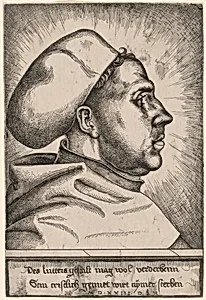
Medium
etching on laid paper
Dimensions
sheet: 22.8 × 15.3 cm (9 × 6 in.)
Classification
Department
CG-E
Museum
National Gallery of Art, Washington, D.C.
Credit
Ruth and Jacob Kainen Memorial Acquisition Fund
Accession Number
2021.68.1
Rights
Public Domain
Art Historical Context
Step into the turbulent world of the Protestant Reformation with this striking 1523 etching, *Martin Luther*, created by Daniel Hopfer after a design by Lucas Cranach the. Hopfer, a pioneering German printmaker, captures the reformer’s resolute gaze and fur-lined robe, faithfully reproducing Cranach’s iconic portrait style. At just 22.8 × 15.3 cm, this intimate sheet packs a powerful punch, now housed in the National Gallery of thanks to the Ruth and Jacobainen Memorial Acquisition Fund. to the height of Luther’s challenge to the Catholic Church—mere years after his 95 Theses—this print played a vital role in spreading his image and message across Europe. Cranach, a close friend and court painter in Wittenberg, produced numerous Luther portraits that symbolized the new Protestant identity. Hopfer’s etching transformed this painted likeness into a reproducible form, making the revolutionary figure accessible to the masses amid religious upheaval. Etching on laid paper was revolutionary here: Hopfer is credited as one of the first to use this acid-resist technique for iron plates, allowing finer lines and tonal depth than earlier engraving. This innovation democratized art, fueling the era’s propaganda and devotion. A testament to art’s power in history!