
Marton
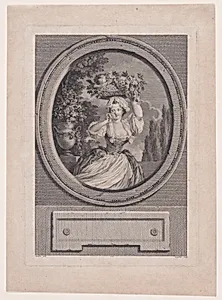
Medium
Engraving
Dimensions
Image: 9 3/16 × 6 9/16 in. (23.4 × 16.7 cm) Plate: 10 1/16 × 7 5/16 in. (25.5 × 18.5 cm) Sheet: 12 in. × 8 7/8 in. (30.5 × 22.5 cm)
Classification
Prints
Department
Drawings and Prints
Museum
Metropolitan Museum of Art, New York, NY
Credit
Harris Brisbane Dick Fund, 1954
Accession Number
54.533.1
Rights
Public Domain
Art Historical Context
"Marton," an enchanting engraving from around 1776, showcases the collaborative talents of French artist Pierre Antoine Baudouin, known for his delicate Rococo designs, and engraver Nicolas Ponce. Created during the late Rococo era in France—a time of opulent, playful art amid the opulence of the Ancien Régime—this print exemplifies how reproductive prints democratized high art. Baudouin's graceful compositions, often featuring elegant figures and pastoral scenes, were masterfully translated by Ponce's precise engraving technique, which involved incising lines into a metal plate for rich, tonal depth. Engravings like this one were prized for their fidelity to original drawings, allowing collectors across Europe to own affordable versions of fashionable works. Measuring about 9 by 6 inches in its image area, "Marton" invites intimate viewing, revealing fine details in textures and expressions that capture the era's refined sensibility. Housed in the Metropolitan Museum of Art's Drawings and Prints department, thanks to the Harris Brisbane Dick Fund of 1954, it reflects the 18th-century boom in printmaking that bridged courtly luxury and bourgeois taste. This piece whispers of cultural shifts too: as Revolution loomed, such whimsical prints offered escapism, preserving Rococo's charm before Neoclassicism's rise. A delightful window into pre-Revolutionary France!
About the Artist
Pierre Antoine Baudouin|Nicolas Ponce · 1723–1769
Comment on works: Genre; History; Allegory