
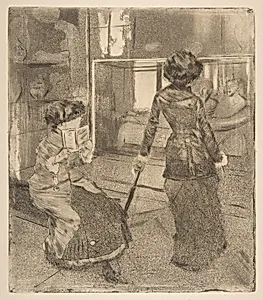
Mary Cassatt at the Louvre: The Etruscan Gallery
Edgar Degas|Mary Cassatt, 1879–80
About this artwork
Step into the refined world of 19th-century Paris with Edgar Degas's *Mary Cassatt at the Louvre: The Etruscan Gallery (1879–80), a intimate print capturing his close friend and fellow Impressionist, the American artist Mary Cassatt. Here, Cassatt is depicted deep in contemplation, sketching amid the ancient Etruscan antiquities of the Louvre Museum. This tender portrait reflects the era's vibrant art scene, where women like Cassatt boldly navigated male-dominated spaces, blending everyday modernity with classical reverence. Degas masterfully employed advanced printmaking techniques—soft-ground etching for fluid, velvety lines; drypoint for sharp, expressive details; aquatint for rich tonal gradations; and etching for precision. Presented in the third state of nine, this version showcases Degas's iterative process, refining textures to evoke the gallery's hushed atmosphere and Cassatt's focused gaze. These methods, innovative for the time, allowed Degas to achieve painterly effects on paper, bridging his oil paintings and intimate pastels. Housed in the Metropolitan Museum of Art's Drawings and Prints department (Rogers Fund, 1919), this work celebrates female artistry and the museum as a creative sanctuary. It underscores the Impressionist fascination with leisure, observation, and the blurred lines between viewer and creator, inviting us to linger, just as Cassatt did.