
Mary Magdalene
c. 1480
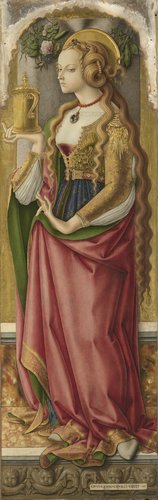
Medium
tempera on panel
Dimensions
152; 49
Rights
Public Domain
About this artwork
Inv.; collection Kaiser Friedrich-Museum, Berlin, 1912; from whom acquired by the dealer I. Rosenbaum, Amsterdam, 1935; from whom aquired by Dr Fritz Mannheimer (1890-1939), Amsterdam, Paris, 1935; purchased from his estate, en bloc, by the Dienststelle Mühlmann, The Hague, for Adolf Hitler's Führermuseum, Linz, 1940;{Korthals Altes 1974, pp. 21-22.} war recuperation, SNK, 1946;{Provenance from 1821 to 1945 reconstructed by Ekkart et al. 2006; MCCP website, file card no. 2795; HNA, SNK Archive, ...
Art Historical Context
Carlo Crivelli’s *Mary Magdalene*, painted around 1480, stands as a striking example of late fifteenth-century Italian panel painting. Executed in tempera on a tall, narrow wooden support measuring 152 by 49 centimeters, the work was likely created as a side panel for an altarpiece. Tempera’s luminous, precise finish allowed artists to render delicate fabrics and symbolic details with remarkable clarity, qualities that suited devotional images intended to inspire quiet contemplation. The painting’s journey through European collections adds another layer of historical interest. Once part of the Kaiser Friedrich-Museum in Berlin, it passed through private hands in Amsterdam before being acquired in 1940 for Adolf Hitler’s planned Führermuseum in Linz. After the war it was recovered and eventually transferred to the Rijksmuseum in 1960, where it remains today. This provenance reflects the turbulent path many Renaissance works followed during the twentieth century, underscoring both their enduring cultural value and the importance of postwar restitution efforts.