
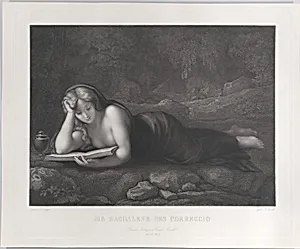
Mary Magdalene reading in the desert
Medium
Engraving
Dimensions
Plate: 14 1/2 × 17 11/16 in. (36.8 × 45 cm) Sheet: 15 9/16 in. × 19 in. (39.5 × 48.3 cm)
Classification
Prints
Department
Drawings and Prints
Museum
Metropolitan Museum of Art, New York, NY
Credit
Gift of Lucy Chauncey, in memory of her father, Henry Chauncey, 1935
Accession Number
35.85.99
Rights
Public Domain
Tags
Art Historical Context
Behold *Mary Magdalene Reading in the Desert*, a captivating 19th-century engraving an original composition by the High master Correggio (Antonio Alleg da Correggio, 1489–1534). Correggio, celebrated for his innovative use of soft, glowing light (known as *sfumato*) and graceful figures, often depicted biblical subjects with emotional depth. Here, the penitent saint Mary Magdalene is shown in contemplative solitude amid a rugged desert landscape, engrossed in scripture—a poignant symbol of spiritual reflection and redemption in Christian iconography. Crafted between 1827 and 1875 by engravers Heinrich Felsing, Ernst Arnold, and Johann Heinrich Friedrich Ludwig Knolle, this print exemplifies the era's reproductive printmaking techniques. Engraving, an intaglio process where intricate lines are incised into a metal plate and inked under pressure, allowed widespread dissemination of Renaissance masterpieces. Measuring 14½ × 17⅝ inches on the plate, its detailed rendering captures Correggio's ethereal beauty, making high art accessible to collectors and scholars. Now in the Metropolitan Museum of Art's Drawings and Prints department (gift of Lucy Chauncey, 1935), this work highlights women's portrayal in devotional art, blending reading—a rare motif for female saints—with themes of introspection. It invites visitors to ponder Magdalene's enduring cultural resonance as a figure of transformation.