
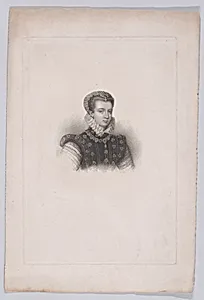
Mary, Queen of Scots
Medium
Stipple engraving
Dimensions
Plate: 9 × 6 in. (22.8 × 15.3 cm) Sheet: 11 1/4 × 7 9/16 in. (28.5 × 19.2 cm)
Classification
Prints
Department
Drawings and Prints
Museum
Metropolitan Museum of Art, New York, NY
Credit
Gift of Susan Dwight Bliss, 1958
Accession Number
58.549.407
Rights
Public Domain
Tags
Art Historical Context
This delicate stipple engraving, titled *Mary, Queen of Scots* and dated October 28, 1822, captures the enigmatic likeness of one of history's most tragic monarchs. Produced by engraver William Bond after an enamel by Henry Bone, and published by Longman, Hurst Rees, Orme, and Brown, it measures a modest plate size of 9 × 6 inches. Stipple engraving, a technique using fine dots to build subtle tones and textures, was prized in the early 19th century for portraits with remarkable clarity and softness, making fine art accessible beyond oil paintings. Mary Stuart (1542–1587), Queen of Scots from infancy, embodied Renaissance intrigue: a Catholic claimant to the English throne, she faced imprisonment and execution by her cousin Elizabeth I amid plots and scandal. By 1822, during the Romantic era's fascination with doomed heroines, this print revived her image, blending historical reverence with sentimental appeal. Such reproductions fueled public imagination through books and magazines. Today, this intimate portrait graces the Metropolitan Museum of Art's Drawings and Prints department, a 1958 gift from Susan Dwight Bliss. It reminds us how prints democratized royal iconography, preserving Mary's poised gaze for generations of admirers.