
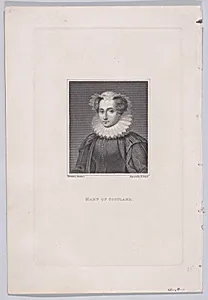
Mary, Queen of Scots
early 19th century
Medium
Stipple engraving
Dimensions
Plate: 7 1/2 × 4 11/16 in. (19.1 × 11.9 cm) Sheet: 9 1/16 × 6 3/16 in. (23 × 15.7 cm)
Classification
Prints
Department
Drawings and Prints
Museum
Metropolitan Museum of Art, New York, NY
Credit
Gift of Susan Dwight Bliss, 1958
Accession Number
58.549.390
Rights
Public Domain
Tags
Art Historical Context
This stipple engraving, created in the early nineteenth century by Robert Cooper, captures the enduring fascination with Mary, Queen of Scots (1542–1587). As a reproductive print, it translates an earlier painted likeness into a widely distributable format, allowing nineteenth-century audiences to connect with one of history’s most romanticized royal figures. The work belongs to the Metropolitan Museum’s collection of prints and drawings, acquired as a gift in 1958. Stipple engraving, the medium employed here, uses countless tiny dots to build delicate tonal gradations and soft modeling—ideal for rendering the textures of lace, velvet, and pearl-studded costumes associated with Tudor and Stuart portraiture. Cooper’s technique reflects the period’s taste for refined, intimate portraits that balanced historical accuracy with sentimental appeal. Beyond its technical merits, the print speaks to the nineteenth-century revival of interest in Mary’s dramatic life—her imprisonment, execution, and enduring legend. Such engravings helped shape popular memory, transforming a contested political figure into a symbol of tragic beauty and resilience for new generations of viewers.