
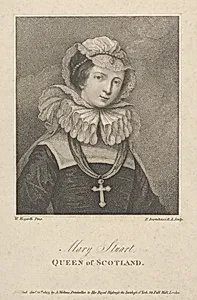
Mary, Queen of Scots
January 12, 1803
Medium
Stipple engraving; fifth state of five
Dimensions
Sheet: 8 7/16 × 6 11/16 in. (21.5 × 17 cm)
Classification
Prints
Department
Drawings and Prints
Museum
Metropolitan Museum of Art, New York, NY
Credit
Gift of Susan Dwight Bliss, 1958
Accession Number
58.549.107
Rights
Public Domain
Tags
Art Historical Context
This delicate stipple engraving, titledMary, Queen of Scots captures the tragic Tudor monarch in a poised portrait, produced on January 12, 1803. Credited to Mary, Queen of Scots alongside engravers Francesco Bartolozzi William Hogarth, it reproduces an earlier design or pattern attributed to the queen herself—perhaps drawing from her renowned embroidery skills—refined through Hogarth's dramatic style and Bartolozzi precise hand. Housed in the Metropolitan Museum of Art's Drawings and Prints department (gift of Susan Dwight Bliss,1958), this fifth and final state measures a modest 8 7/16 × 6 11/16 inches, ideal for intimate collector's albums. Mary Stuart (1542–1587), Queen of Scots, remains a symbol of royal intrigue, Catholic resistance, and Elizabethan drama, her life inspiring endless fascination. Printed over two centuries after her execution, this work reflects 19th-century Romantic nostalgia for her elegance amid adversity, evoking her as both sovereign and martyr. Stipple engraving, Bartolozzi's specialty, employs fine dots to create soft tonal gradients, mimicking painterly effects in black-and-white. As the fifth state of five, it represents the print's most refined iteration, showcasing evolving plate work for subtle shading and detail— a testament to the era's reproductive print culture, making elite imagery accessible to a broader audience.