
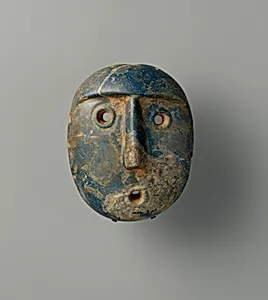
Mask
400 BCE–700 CE
Medium
Stone (lapis lazuli)
Dimensions
H. 6 3/4 × W. 5 × D. 2 in. (17.1 × 12.7 × 5.1 cm)
Classification
Stone Sculpture
Culture
Condorhuasi-Alamito
Department
Arts of Africa, Oceania, and the Americas
Museum
Metropolitan Museum of Art, New York, NY
Credit
Gift of Claudia Quentin, 2015
Accession Number
2015.598
Rights
Public Domain
Tags
Art Historical Context
This exquisite stone mask, carved from the rare and vibrant lapis lazuli by of the Condorhu-Alamito culture,ails from ancient northwestern Argentina, dating between 400 BCE and 700 CE. Measuring just 6¾ inches high, its compact form belies its cultural weight, belonging to the early pre-Columbian traditions of the southern Andes. The deep blue hue of lapis lazuli—a semi-precious stone prized across ancient civilizations for its celestial symbolism—highlights the skill and resources commanded by these artisans, who worked in the rugged Puna highlands. As a stone sculpture classified in the Arts of Africa, Oceania, and the Americas, the mask's stylized facial features evoke mystery and ritual power, common in indigenous Andean art for ceremonies, shamanic practices, or ancestral veneration. The Condorhuasi-Alamito peoples, known from archaeological sites in Catamarca province, produced such objects amid a formative era of emerging social complexity, blending functionality with symbolic expression. Techniques likely involved careful abrasion and polishing to capture the stone's luminous quality, transforming raw material into a portal to the spiritual world. Now a gift to the Metropolitan Museum of Art from Claudia Quentin in 2015, this mask invites visitors to ponder the enduring gaze of pre-Columbian faces, bridging millennia of human creativity.