
Mask
Unknown Artist
ca. 1900
Medium
Wood, pigment, vegetal fiber, iron nails, and feathers
Dimensions
34 1/2 × 22 × 9 1/2 in. (87.6 × 55.9 × 24.1 cm)
Classification
Mask
Culture
Yup'ik, Native American
Department
The American Wing
Museum
Metropolitan Museum of Art, New York, NY
Credit
The Charles and Valerie Diker Collection of Native American Art, Gift of Valerie-Charles Diker Fund, 2017
Accession Number
2017.718.3
Rights
Public Domain
Tags
Art Historical Context
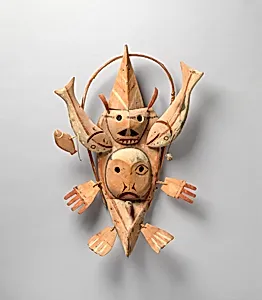
This striking wooden mask, created by an unknown Yup'ik artist around 1900, hails from the Native American communities of southwestern Alaska. Crafted from wood, adorned with pigments, vegetal fibers iron nails, and feathers it measures an imposing 34½ × 22 × 9½ inches. Acquired through the Charles and Valerie Diker Collection now housed in The Metropolitan Museum of Art's American Wing, it exemplifies the rich tradition of Yup'ik mask-making. Yup'ik masks profound cultural and spiritual significance, often worn during winter festivals, dances, and hunting rituals to invoke animal spirits, ensure successful hunts, and connect the human world with the supernatural. The prominent fish motif—evident in its design—reflects the Yup'ik's deep reliance on salmon and marine life for sustenance, symbolizing abundance, transformation, and the cyclical rhythms of nature in their coastal environment. Artistically, the mask showcases masterful carving techniques, with bold pigments enhancing exaggerated features for dramatic effect in dimly lit kashim (communal houses). The incorporation of iron nails, likely traded from Europeans, highlights early 20th-century cultural exchanges, blending indigenous ingenuity with introduced materials. Feathers and fibers add texture and movement, bringing the spirit to life during performances. A powerful testament to Yup'ik artistry and worldview.