
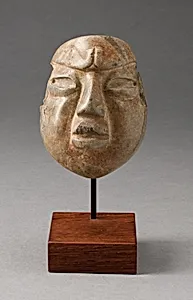
Mask
200 BCE–300 CE
Medium
Serpentine
Dimensions
H.: 7.9 cm (3 1/8 in.)
Classification
stone
Department
Arts of the Americas
Museum
Art Institute of Chicago
Accession Number
148338
Rights
Public Domain
Art Historical Context
This exquisite Olmec mask, carved from smooth serpentine stone, dates to the Late Formative period (200 BCE–300 CE) stands just 7.9 cm tall, making it a remarkably intimate artifact from one of Mesoamerica's earliest civilizations. Olmecs, often called the "mother culture" of Mexico and Central America, flourished along the Gulf Coast from around 1200 BCE, pioneering monumental stone sculptures and intricate jade-like carvings. Serpentine, with its rich green hue and waxy polish, was prized for evoking jade's sacred qualities, symbolizing vitality and otherworldly power. Olmec masks like this one were likely worn during rituals by shamans, rulers, or priests, facilitating transformation into divine or ancestral beings. The culture's distinctive style—often featuring rounded, infant-like faces with downturned mouths and slit eyes—conveys introspection and supernatural authority, influencing later Mesoamerican art from the Maya to the Aztecs. Carved with masterful precision using simple stone tools, this piece exemplifies the Olmecs' technical prowess and spiritual worldview. Housed in the Art Institute of Chicago's Arts of the Americas department, it invites us to ponder the ancient wearer's gaze across millennia, bridging visitors to a world of cosmic rituals and enduring mystery.