
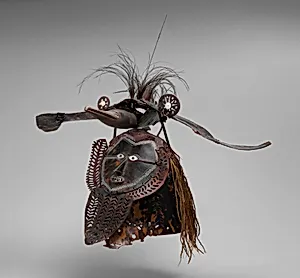
Mask (Buk, Krar, or Kara)
Unknown Artist
mid to late 19th century
Medium
Turtle shell, wood, cassowary feathers, fiber, resin, shell, paint
Dimensions
H. 21 1/2 x W. 25 x D. 22 3/4 in. (54.6 x 63.5 x 57.8 cm)
Classification
Costumes
Culture
Torres Strait Islander
Department
Arts of Africa, Oceania, and the Americas
Museum
Metropolitan Museum of Art, New York, NY
Credit
The Michael C. Rockefeller Memorial Collection, Purchase, Nelson A. Rockefeller Gift, 1967
Accession Number
1978.412.1510
Rights
Public Domain
Tags
Art Historical Context
This striking mask, known as a *buk*, *krar*, or *kara*, hails from the Torres Strait Islanders, the Indigenous peoples of the islands between Australia and Papua New. Crafted by an unknown artist in the- to late 19th, it exemplifies the rich tradition of ceremonial costumes in Torres Strait culture. Measuring about 21½ inches high, its robust form—fashioned from turtle shell, wood, cassary feathers, fiber, resin, shell, and paint—demonstrates masterful use of local materials, blending natural textures and vibrant colors to create a powerful, otherworldly presence. In Torres Strait Islander society, such masks were vital to rituals, dances, and storytelling, likely embodying ancestral spirits, mythical beings, or protective forces. The prominent cassowary feathers, from the striking flightless bird native to the region, evoke themes of strength, agility, and the natural world, while the layered construction with resin and paint highlights innovative assembly techniques that ensured durability during performances. This artifact captures a pre-colonial artistic vitality, preserved today in The Metropolitan Museum of Art's Michael C. Rockefeller Memorial Collection. Visitors, imagine donning this mask amid rhythmic drumming and chants—its tactile, feathered surface alive with cultural memory, bridging the human and spiritual realms.