
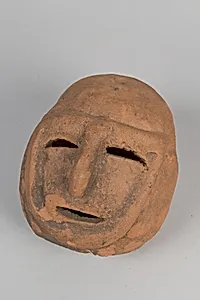
Masked Haniwa Figure
Unknown Artist
Medium
Earthenware
Dimensions
H. 5 3/4 in. (14.6 cm); W. 4 7/8 in. (12.4 cm); Diam. 5 1/4 in. (13.3 cm)
Classification
Sculpture
Culture & Period
Japan · Kofun period (ca. 300–710)
Department
Asian Art
Museum
Metropolitan Museum of Art, New York, NY
Credit
The Harry G. C. Packard Collection of Asian Art, Gift of Harry G. C. Packard, and Purchase, Fletcher, Rogers, Harris Brisbane Dick, and Louis V. Bell Funds, Joseph Pulitzer Bequest, and The Annenberg Fund Inc. Gift, 1975
Accession Number
1975.268.416
Rights
Public Domain
Tags
Art Historical Context
This petite Masked Haniwa, crafted from earthenware during Japan's Kofun period (. 300–710 CE), stands as a captivating relic from an era of ancient burial practices. Haniwa—hollow clay sculptures like this one—were ritually placed around elite tomb mounds (kofun) to serve as spiritual guardians, offerings, or substitutes for human sacrifices. Measuring just 5 3/4 inches tall, its compact form suggests it was one of many mass-produced figures, fired in kilns to create a durable, reddish-brown surface typical of the medium. The figure's enigmatic masked face, with its stylized features and tags evoking mystery, hints at shamanistic or ceremonial roles, possibly linked to rituals honoring the deceased or warding off evil spirits. Artisans hand-built these from coiled clay, emphasizing simple, expressive forms over intricate detail, which underscores the Kofun culture's focus on communal ancestor worship amid Japan's shift from Yayoi rice-farming societies to hierarchical chiefdoms. Housed in the Metropolitan Museum of Art's Asian Art Department as part of The Harry G. C. Packard Collection, this piece offers a window into early Japanese spirituality, where everyday earthenware became vessels for the eternal. Visitors, imagine clusters of such figures encircling massive keyhole-shaped tombs—silent sentinels bridging the living and the afterlife.