
Massacre of the Innocents
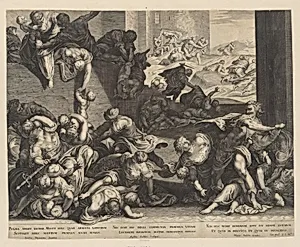
Medium
Engraving; third state of four (Hollstein)
Dimensions
Sheet (Trimmed): 15 7/16 × 19 7/16 in. (39.2 × 49.3 cm)
Classification
Prints
Department
Drawings and Prints
Museum
Metropolitan Museum of Art, New York, NY
Credit
The Elisha Whittelsey Collection, The Elisha Whittelsey Fund, 1949
Accession Number
49.95.2295
Rights
Public Domain
Tags
Art Historical Context
This engraving captures the dramatic biblical scene of the Massacre of the Innocents, in which King Herod orders the slaughter of young children in Bethlehem. Created around 1600 by engravers Aegid Sadeler II and Marcuseler after a composition by the Venetian master Jacopo Tintoretto, the print translates the painter’s dynamic, emotionally charged style into a detailed black-and-white medium. Tintoretto, a leading figure of late Renaissance Venice, was renowned for his energetic figures and theatrical lighting, qualities that the Sadelers carefully preserved through precise line work. As a third state of four, this impression reflects the careful evolution of the plate during printing. Engravings like this one played a vital role in the early seventeenth century by allowing important religious and artistic subjects to reach wider audiences across Europe. Produced in the workshop of the Sadeler family, skilled Flemish printmakers active in Prague and elsewhere, the work helped spread Venetian artistic ideas northward while serving devotional and educational purposes during the Counter-Reformation. Measuring roughly 39 by 49 centimeters, the sheet’s generous scale allows viewers to appreciate the intricate network of lines that convey movement and pathos. Now in the Metropolitan Museum of Art’s collection, it stands as a fine example of how prints bridged painting and popular devotion, preserving powerful narratives for generations of museum visitors.
About the Artist
Aegidius Sadeler II|Jacopo Tintoretto (Jacopo Robusti)|Marcus Sadeler · 1568–1629
Netherlandish, Antwerp 1568–1629 Prague