
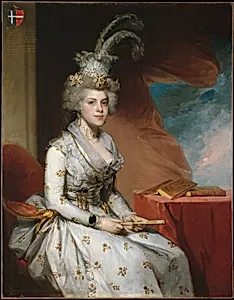
Matilda Stoughton de Jaudenes
1794
Medium
Oil on canvas
Dimensions
50 5/8 x 39 1/2 in. (128.6 x 100.3 cm)
Classification
Painting
Culture
American
Department
The American Wing
Museum
Metropolitan Museum of Art, New York, NY
Credit
Rogers Fund, 1907
Accession Number
07.76
Rights
Public Domain
Tags
Art Historical Context
Gilbert Stuart's *Matilda Stoughton de Jenes* (1794) is a masterful oil-on-canvas portrait capturing the elegance of an early American elite woman. Measuring an impressive 50⅝ × 39½ inches, this large-scale work exemplifies Stuart's prowess as one of America's premier portraitists during the Federal period. Matilda, the Philadelphia-born wife of Spanish diplomat José de Jaud, embodies the cultural fusion of the young republic's transatlantic ties, her poised demeanor reflecting the refined society of post-Revolutionary Philadelphia. Painted at the height of Stuart's career—fresh from his iconic George Washington portraits—this piece showcases his signature techniques: luminous skin tones achieved through delicate glazing, a direct gaze that conveys inner character, and rich fabrics that highlight social status. Oil on canvas allowed Stuart to layer subtle textures, from the subject's pearl jewelry to the soft folds of her gown, creating a lifelike presence that drew admiration from contemporaries. Housed in The Metropolitan Museum of Art's American Wing since 1907 (Rogers Fund), the portrait offers a window into 18th-century women's roles amid diplomatic circles. Its enduring appeal lies in Stuart's ability to blend European portrait traditions with American vitality, making it a highlight for visitors exploring the nation's formative artistic identity.
About the Artist
Gilbert Stuart · 1755–1828
Gilbert Stuart (1755–1828) was born on December 3, 1755, in Saunderstown, Rhode Island. He received his first painting instruction from local portraitist Samuel King, then studied under Scottish artist Cosmo Alexander who brought him to Scotland in 1771. After Alexander died, Stuart returned to Newport before sailing to London in 1775, where he entered the studio of Benjamin West for approximately...