
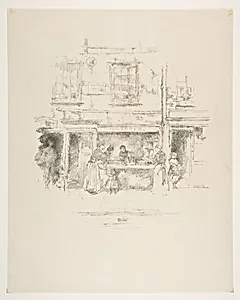
Maunder's Fish Shop, Chelsea
Medium
Transfer lithograph with scraping; second state of two (Chicago); printed in black ink on smooth ivory wove paper
Dimensions
Image: 7 1/16 × 6 3/4 in. (18 × 17.2 cm) Sheet: 10 7/8 x 8 11/16 in. (27.6 x 22.1 cm)
Classification
Prints
Department
Drawings and Prints
Museum
Metropolitan Museum of Art, New York, NY
Credit
Gift of Paul F. Walter, 1984
Accession Number
1984.1119.4
Rights
Public Domain
Tags
Art Historical Context
James McNeill Whistler’s *Maunder’s Fish Shop, Chelsea* captures a quiet moment on a London street in 1890. The American-born artist, then living in the Chelsea neighborhood, often turned his attention to everyday urban scenes, transforming ordinary shops and passersby into elegant compositions. Here, the modest fish shop and surrounding buildings are rendered with delicate lines and subtle tonal contrasts, reflecting Whistler’s lifelong interest in atmosphere and suggestion over strict realism. Created as a transfer lithograph with scraping, the print showcases Whistler’s innovative approach to the medium. He drew directly on specially prepared paper before transferring the image to a lithographic stone, then used scraping to refine tones and details. This second state of two allowed him to achieve the soft, atmospheric effects he admired in both Japanese prints and European old-master drawings. Printed in black ink on smooth ivory wove paper, the work demonstrates lithography’s potential for intimate, painterly results. As part of Whistler’s extensive series of London lithographs, this piece offers a glimpse into late-Victorian Chelsea life while highlighting the artist’s role in elevating printmaking to fine art. The small scale—roughly seven by seven inches—invites close viewing, rewarding the eye with Whistler’s characteristic economy of line and sensitivity to light and texture.
About the Artist
James McNeill Whistler · 1834–1903
James Abbott McNeill Whistler (1834-1903) was an American-born painter and printmaker who became a leading figure in the Aesthetic Movement and pioneer of Tonalism and Japonisme. He revolutionized art by championing "art for art's sake" and treating paintings as visual equivalents of musical compositions, titling works as "arrangements," "harmonies," and "nocturnes" to emphasize formal qualities o...