
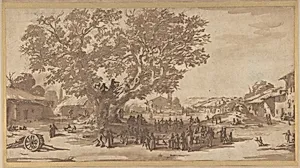
May Day Celebrations at Xeuilley
ca. 1624–25
Medium
Pen and brown ink, brush and brown wash
Dimensions
sheet: 7 x 13 1/16 in. (17.8 x 33.2 cm)
Classification
Drawings
Department
Drawings and Prints
Museum
Metropolitan Museum of Art, New York, NY
Credit
Purchase, Rogers Fund and several members of The Chairman's Council Gifts, 2008
Accession Number
2008.74
Rights
Public Domain
Tags
Art Historical Context
Jacques Callot's *May Day Celebrations ateuilley* (ca. 1624–25) captures the joyful spirit of a rural French village festival in vibrant detail. Rendered in pen and brown ink with brush and brown wash, drawing depicts villagers dancing amid trees and thatched roofs, evoking the lively communal traditions of early 17th-century Lorraine, where Callot, a master draftsman from Nancy, often drew inspiration from local life. The modest sheet size (7 x 13 1/16 in.) belies its intricate composition, showcasing human figures in exuberant motion—a hallmark of Callot's Baroque style, known for dynamic crowd scenes in prints like his famous festival series. May Day, or *La Mi-Carême*, was a cherished spring rite in Europe, blending pagan fertility rituals with Christian festivities. In Xeuilley, a real village near Nancy, residents would gather around maypoles for dances and games, as Callot meticulously records here. This work highlights cultural continuity in rural France amid the era's religious wars and social upheavals. Callot's technique—precise ink lines for figures and architecture, softened by brown wash for depth—demonstrates his genius for storytelling on paper. Likely a study for etching, it exemplifies how drawings served as vital precursors to his influential prints, preserving fleeting moments of peasant merriment for posterity. A gem in the Metropolitan Museum of Art's Drawings and Prints collection.
About the Artist
Jacques Callot · 1592–1635
Jacques Callot (1592–1635) was a French printmaker and draftsman from the Duchy of Lorraine, widely regarded as one of the first great artists to practice the graphic arts exclusively. His more than 1,400 etchings chronicled the breadth of 17th-century life, from Medici court festivities to the brutal realities of warfare. Callot revolutionized etching through technical innovations including the é...