
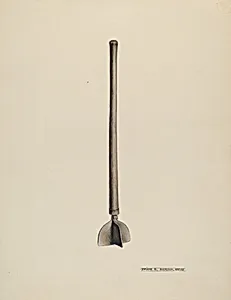
Meat Chopper
c. 1939
Medium
watercolor, pen and ink, and gouache on paper
Dimensions
overall: 35.8 x 36.7 cm (14 1/8 x 14 7/16 in.) Original IAD Object: blade: 7" wide; 4" high; overall: 36" high
Classification
Index of American Design
Department
CG-W
Museum
National Gallery of Art, Washington, D.C.
Credit
Index of American Design
Accession Number
1943.8.9388
Rights
Public Domain
Art Historical Context
In the National Gallery of Art's collection, *Meat Chopper* (c. 1939) by Eugene R. Szepessy captures the sturdy elegance of an everyday American folk tool—a heavy-duty blade for chopping meat, measuring 7 inches wide and 4 inches high on a 36-inch handle. Rendered in watercolor, pen and ink, and gouache on paper (35.8 x 36.7 cm), Szepessy's precise depiction highlights the chopper's functional beauty, from its broad, curved blade to its worn wooden haft, evoking the craftsmanship of rural American life. This artwork is part of the Index of American Design, a landmark WPA Federal Art Project from the 1930s that employed artists to document the nation's folk art and design heritage during the Great Depression. Szepessy, a skilled illustrator, contributed to this effort by creating vivid, accurate renderings that preserved vanishing utilitarian objects, celebrating their role in American material culture. The mixed-media technique—combining ink's fine lines for detail, watercolor's fluidity, and gouache's opacity for bold color—allows for a lifelike study that bridges art and artifact. Today, it reminds visitors of how ordinary tools embodied regional ingenuity and resilience, inviting us to appreciate the artistry in the everyday.