
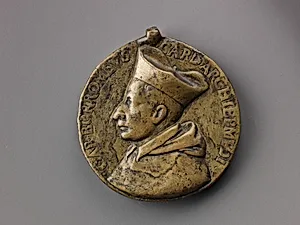
Medal: Bust of Carlo Borromeo
Unknown Artist
ca. 1600 (possibly cast in the 19th century)
Medium
Bronze (copper alloy with dull yellowish natural patina and remains of an abraded black patina)
Dimensions
Diam. 4.9 cm, wt. 46.2 g
Classification
Medals
Culture
Italian, Milan (?)
Department
Robert Lehman Collection
Museum
Metropolitan Museum of Art, New York, NY
Credit
Robert Lehman Collection, 1975
Accession Number
1975.1.1255
Rights
Public Domain
Tags
Art Historical Context
This exquisite bronze medal features a profile bust of Saint Borromeo, the 16th-century Archbishop of Milan and a pivotal figure in the Catholic Counter-Reformation. Born in 1538 and canonized shortly after his death in 1584, Borromeo was renowned for his zealous reforms, charitable works, and spiritual leadership during a turbulent era of religious upheaval. Produced around 1600—possibly in Milan—the medal captures his solemn visage, likely accompanied by lambs symbolizing his pastoral devotion to his flock, a common motif in saintly iconography. Though the artist remains unknown, such small-scale portraits were prized as devotional objects or collectibles, blending piety with portraiture. Crafted from copper alloy bronze, the medal measures just 4.9 cm in diameter and weighs a substantial 46.2 grams, suggesting a solid cast rather than a struck piece. Its dull yellowish natural patina, overlaid with traces of an abraded black patina, evokes the passage of time and hints at later casting, potentially in the 19th century from an original 17th-century mold—a practice common for preserving Renaissance-era designs. Medals like this were artistic microcosms of larger sculptures, showcasing virtuoso relief work in miniature. Housed in the Metropolitan Museum of Art's Robert Lehman Collection since 1975, this piece exemplifies the intimate artistry of Italian Renaissance medals, offering visitors a tangible connection to Borromeo's enduring legacy of faith and reform.