
Medal of Honor
Unknown Artist
late 19th century
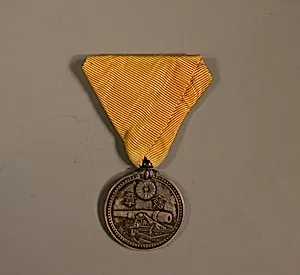
Medium
Yellow ribbon
Dimensions
2 7/8 × 1 7/8 in. (7.3 × 4.8 cm)
Classification
Medals
Culture & Period
Japan · Meiji period (1868–1912)
Department
Asian Art
Museum
Metropolitan Museum of Art, New York, NY
Credit
Gift of Edward D. Adams and Jacob H. Schiff, 1906
Accession Number
06.447
Rights
Public Domain
Tags
Art Historical Context
This exquisite *Medal of Honor* late 19th-century Japan, crafted during the Meiji period (8–1912), the nation's rapid modernization and military reforms. Presented on a striking yellow ribbon—measuring just 2 7/8 × 1 7/8 inches (7.3 × 4.8 cm)—this small yet potent artifact was likely awarded for acts of, reflecting Japan's shift from isolation to imperial power. The tag associating it with "cannons" hints at its connection to artillery achievements or wartime service, a nod to the era's embrace of Western military technology amid conflicts like the Sino-Japanese War (1894–1895). In the Meiji period, Japan transformed its feudal samurai traditions into a modern army, commissioning medals that blended intricate Japanese craftsmanship with European designs. These honors, classified as official insignia, symbolized national pride and loyalty to the emperor. The yellow ribbon, a deliberate choice, may denote a specific rank or branch, underscoring the precision of Meiji-era metalwork and textile artistry. A generous gift to the Metropolitan Museum of Art in 1906 from Edward D. Adams and Jacob H. Schiff, this medal offers visitors a tangible link to Japan's pivotal modernization. Though by an unknown artist, it captures the cultural fusion that propelled Japan onto the world stage.