
Medallion
1870–1900
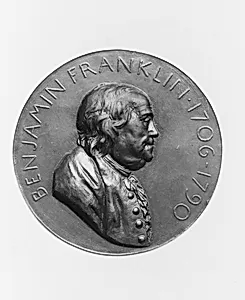
Medium
Copper-brown galvano patina
Dimensions
Diam. 3 1/2 in. (8.9 cm)
Classification
Medallion
Department
The American Wing
Museum
Metropolitan Museum of Art, New York, NY
Credit
Gift of William H. Huntington, 1883
Accession Number
83.2.164
Rights
Public Domain
Tags
Art Historical Context
This elegant medallion, created by Jean Martin Rena between 1870 and 1900, presents a profile portrait of Benjamin Franklin, one of America’s most celebrated Founding Fathers. Measuring just 3½ inches in diameter, the work captures Franklin’s distinctive features in a classic commemorative style that echoes ancient coinage and Renaissance medals. Housed in the Metropolitan Museum’s American Wing, it reflects the enduring fascination with Franklin as a symbol of ingenuity, diplomacy, and democratic ideals long after his lifetime. The piece is executed in copper-brown galvano patina, a 19th-century electroplating technique that allowed artists to produce finely detailed metal reliefs with a warm, aged appearance. This medium was prized for its ability to replicate intricate designs while remaining lightweight and durable, making such medallions popular for both private collections and public display. The subtle tonal variations in the patina enhance the sense of depth in the profile, lending the small object a monumental quality. Donated to the museum in 1883 by William H. Huntington, the medallion serves as a tangible link between 18th-century American history and the later 19th-century revival of interest in the nation’s founders. Its presence in the collection underscores how portrait medallions functioned as accessible forms of historical remembrance, bridging fine art and popular culture.
About the Artist
Jean Martin Renaud (French) · 1746 –1821
French, Sarreguemines 1746–1821 Paris