
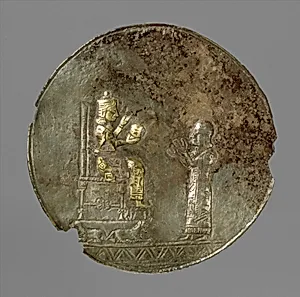
Medallion with a seated deity and a male worshiper
Unknown Artist
ca. 8th–7th century BCE
Medium
Silver, gold foil
Dimensions
2 3/8 × 2 3/8 × 1/16 in. (6.1 × 6.1 × 0.2 cm)
Classification
Metalwork-Ornaments
Culture & Period
Urartian · Iron Age III
Department
Ancient Near Eastern Art
Museum
Metropolitan Museum of Art, New York, NY
Credit
Gift of Norbert Schimmel Trust, 1989
Accession Number
1989.281.20
Rights
Public Domain
Tags
Art Historical Context
This delicate silver medallion, overlaid with shimmering gold foil, hails from the Urartian culture of the Iron Age III periodca. 8th–7th century BCE). just 2 3/8 inches square, it captures a poignant scene: a seated deity, enthroned in majesty, attended by a male worshiper in a gesture of reverence. Such intimate scale suggests it was likely worn as an amulet, pendant, or decorative ornament, blending everyday devotion with divine encounter. Urartu, a formidable kingdom in the Armenian Highlands near Lake Van, rivaled the Assyrians and excelled in metalwork, as seen in this piece's fine repoussé technique—hammering the thin silver sheet to create raised figures. The gold foil overlay added luster and prestige, symbolizing the sacred. These medallions reflect Urartian religious life, where deities demanded homage, underscoring a worldview of cosmic hierarchy and human piety. Today, this rare survivor graces the Metropolitan Museum of Art's Ancient Near Eastern collection, a gift of the Norbert Schimmel Trust in 1989. It invites us to ponder the timeless human impulse to connect with the divine through art.