
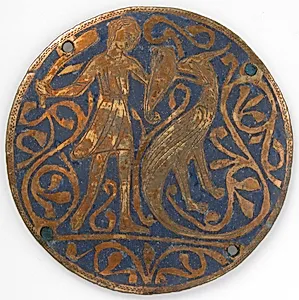
Medallion with Man Fighting Basilisk
Unknown Artist
ca. 1240–60
Medium
Copper: engraved and gilt; champlevé enamel: medium and light blue and white
Dimensions
Overall: 3 1/2 x 1/16 in. (8.9 x 0.2 cm)
Classification
Enamels-Champlevé
Culture
French
Department
Medieval Art
Museum
Metropolitan Museum of Art, New York, NY
Credit
Gift of J. Pierpont Morgan, 1917
Accession Number
17.190.2149
Rights
Public Domain
Tags
Art Historical Context
This delicate medallion, created by an unknown French artist around 1240–60, captures a thrilling medieval confrontation: a determined man locked in combat with a basilisk, the mythical serpent-king whose deadly gaze and venom struck terror in folklore. Measuring just 3 1/2 inches across and remarkably thin at 1/16 inch, this tiny treasure was likely designed for personal devotion, such as adorning a reliquary, book cover or jewelry, embodying the era's fascination with moral tales from bestiaries. Crafted in engraved and gilt copper with champlevé enamel in vibrant medium and light blues accented by white, the piece highlights a sophisticated 13th-century technique. Champlevé involved incising cells into the metal base, filling them with ground glass enamel, and firing to fuse vivid, translucent colors—perfect for luminous effects on a small scale. This method, prominent in French medieval workshops, produced durable, jewel-like objects blending artistry and piety. Housed in the Metropolitan Museum of Art's Medieval Art department (gift of J. Pierpont Morgan, 1917), the medallion reflects Gothic-era storytelling, where mythical beasts like the basilisk often symbolized evil or temptation overcome by human virtue. Its exquisite detail invites visitors to marvel at the anonymous artisan's mastery, bridging myth, faith, and fine craft.