
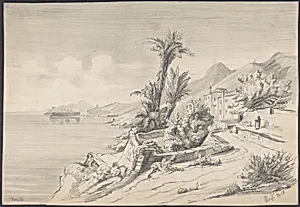
Mediterranean landscape (recto); Mountains (verso)
1830–64
Medium
Graphite
Dimensions
sheet: 10 1/16 x 14 3/4 in. (25.6 x 37.4 cm)
Classification
Drawings
Department
Drawings and Prints
Museum
Metropolitan Museum of Art, New York, NY
Credit
Gift of Eugene L. Garbaty, 1953
Accession Number
53.685.53
Rights
Public Domain
Tags
Art Historical Context
Alexandre Calame, a leading Swiss Romantic artist of the 19th century captured the sublime beauty of nature in this double-sided graphite drawing from around 1830–64. On the recto, a serene *Mediterranean landscape* with rolling hills and distant seas, the verso features rugged *mountains*, showcasing Calame's masterful ability to evoke the grandeur of the Alps and southern coasts. Rendered in graphite on a modest 10 1/16 x 14 3/4-inch sheet, these sketches highlight his precision and atmospheric depth, typical of preparatory studies that informed his larger oil paintings. Calame, often called the "painter of the Alps," rose to fame in the Romantic era for idealizing Switzerland's dramatic terrain, blending realism with emotional intensity. Graphite, a versatile medium favored by draftsmen, allowed him to layer tones for luminous effects—shadowy valleys on one side contrasting sunlit peaks on the other. This recto-verso format was practical for artists traveling en plein air, capturing fleeting vistas quickly. Now in the Metropolitan Museum of Art's Drawings and Prints department, thanks to a 1953 gift from Eugene L. Garbaty, the work exemplifies Calame's enduring influence on landscape art, bridging Romantic sublime with emerging Realism. Visitors will appreciate its intimate scale, inviting a closer look at nature's quiet poetry.
About the Artist
Alexandre Calame · 1810–1864
Comment on works: Landscapes