
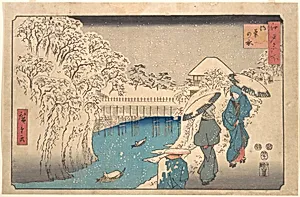
江戸名所 御茶の水|Meguro
early 20th century
Medium
Woodblock print; ink and color on paper
Dimensions
10 x 14 1/2 in. (25.4 x 36.8 cm)
Classification
Prints
Culture & Period
Japan · Meiji (1868–1912) or Taishō (1912–26) period
Department
Asian Art
Museum
Metropolitan Museum of Art, New York, NY
Credit
Gift of Cole J. Younger, 1975
Accession Number
JP3438
Rights
Public Domain
Tags
Art Historical Context
This woodblock print by Utagawa Hiroshige captures iconic views of Edo’s celebrated sites, including Ochanomizu and Meguro, rendered in delicate ink and color on paper. Created during Japan’s Meiji (1868–1912) or Taishō (1912–1926) period, the work reflects the lasting appeal of ukiyo-e traditions even as Japan modernized. Snow-covered trees, graceful bridges, boats on the water, and figures of women evoke a tranquil winter atmosphere, inviting viewers to appreciate the poetic beauty of familiar landscapes. Hiroshige’s mastery of the woodblock medium is evident in the subtle gradations of color and precise lines that bring depth to the scene. Such prints were originally produced in multiple editions for a wide audience, serving both as affordable art and as visual records of places that held deep cultural resonance. The inclusion of everyday details alongside natural elements highlights the artist’s skill in balancing human presence with the changing seasons. Now part of the Metropolitan Museum of Art’s Asian Art collection through a 1975 gift, this piece continues to offer visitors a window into Japan’s rich printmaking heritage and its celebration of place.
About the Artist
Utagawa Hiroshige · 1826–1869
Utagawa Hiroshige (1797–1858), born Andō Tokutarō, was the last great master of Japanese ukiyo-e woodblock printmaking and one of the most influential landscape artists in history. Born in Edo (modern Tokyo) into a low-ranking samurai family serving as fire wardens, Hiroshige transformed landscape printmaking into a poetic meditation on nature, weather, and everyday life. His revolutionary approac...