
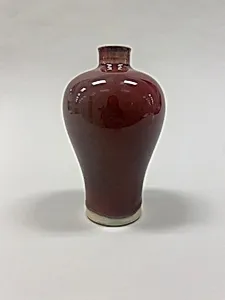
Meiping vase
Unknown Artist
18th century
Medium
Porcelain with copper red glaze (Jingdezhen ware)
Dimensions
H. 5 3/8 in. (13.7 cm); Diam. 3 1/4 in. (8.3 cm)
Classification
Ceramics
Culture & Period
China · Qing dynasty (1644–1911)
Department
Asian Art
Museum
Metropolitan Museum of Art, New York, NY
Credit
Bequest of Benjamin Altman, 1913
Accession Number
14.40.71
Rights
Public Domain
Art Historical Context
This delicate Meiping vase, a petite porcelain treasure from China's Qing dynasty (1644–1911), exemplifies the exquisite craftsmanship of 18th-century Jingdezhen. Standing just 5⅜ inches tall with a 3¼-inch, its pear-shaped form—narrow neck flaring to a rounded body—is a classic meiping design, traditionally used to display slender plum blossoms, evoking the poetic elegance of Chinese literati culture. Produced in Jingdezhen, the world's porcelain capital, this piece features a striking copper red glaze, a technical marvel achieved through precise control of copper oxide in the kiln to yield its vibrant, oxblood hue. The copper red glaze, also known as sang de boeuf, was highly prized during the Qing era for its rarity and depth, reflecting imperial patronage of innovative ceramic techniques. Though the artist remains unknown, the vase's flawless execution highlights the anonymous mastery of Jingdezhen kilns, where potters pushed the boundaries of monochrome glazes amid booming export trade. Bequeathed to the Metropolitan Museum of Art by Benjamin Altman in 1913, it invites visitors to appreciate the subtle beauty of Qing ceramics—timeless symbols of refinement and harmony in Asian art.