
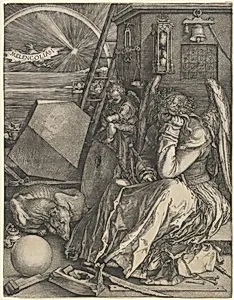
Melencolia I
1514
Medium
engraving on laid paper
Dimensions
sheet (trimmed to image): 24.2 x 18.8 cm (9 1/2 x 7 3/8 in.)
Classification
Department
CG-E
Museum
National Gallery of Art, Washington, D.C.
Credit
Rosenwald Collection
Accession Number
1943.3.3522
Rights
Public Domain
Art Historical Context
Albrecht Dürer's *Melencolia I* (1514) stands as one of the most enigmatic masterpieces of the Northern Renaissance. This intimate engraving on laid paper, measuring just 24.2 x 18.8 cm, captures a winged female figure surrounded by an array of symbolic objects—a magic square, hourglass, scales, and a massive polyhedron—evoking the melancholic temperament associated with artistic genius. Housed in the National Gallery of Art's Rosenwald Collection, it exemplifies Dürer's mastery of printmaking, a revolutionary medium that allowed his works to reach a wide audience across Europe. Dürer, a German artist and theorist (1471–1528), elevated engraving to fine art through his precise burin technique, rendering extraordinary detail and texture on small copper plates. Created at the height of his career, *Melencolia I* reflects Renaissance humanism's fascination with intellect, science, and the artist's inner turmoil, drawing from classical ideas of the four humors. Its intricate composition invites endless interpretation, blending mathematics, alchemy, and introspection. This print's cultural legacy endures as a touchstone for themes of creativity and frustration, influencing artists from Rembrandt to modern thinkers. Visitors are drawn to its mystery, pondering what frustrated genius the title hints at in Dürer's own life.
About the Artist
Albrecht Dürer · 1471–1528
Albrecht Dürer (1471–1528) stands as the preeminent figure of the Northern Renaissance and arguably the most influential artist in the history of printmaking. Born in Nuremberg on May 21, 1471, and dying in the same city on April 6, 1528, Dürer revolutionized the status of the artist in Northern Europe, transforming printmaking from a commercial craft into an independent fine art and establishing ...