
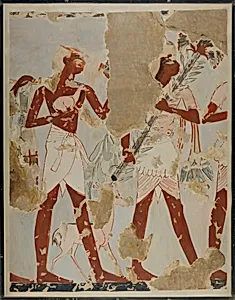
Men Bringing Offerings, Tomb of Qenamun
ca. 1479–1400 B.C.
Medium
Tempera on paper
Dimensions
H. 45 cm (17 11/16 in); w. 35.5 cm (14 in) scale 1:1
Classification
Facsimile, Qenamun (TT 162), offering bearers, male
Period
New Kingdom
Department
Egyptian Art
Museum
Metropolitan Museum of Art, New York, NY
Credit
Rogers Fund, 1930
Accession Number
30.4.193
Rights
Public Domain
Art Historical Context
Welcome to the Egyptian Art galleries at the Metropolitan Museum of Art, where we encounter *Men Bringing Offerings* from the Tomb of Qenamun, a vivid facsimile created by Charles K. Wilkinson 1930. This tempera-on-paper reproduction, at a precise 1:1 scale (45 x 35.5 cm), faithfully captures a wall painting from Egypt's New Kingdom, Dynasty18 (ca. 1479–1400 B.C.). It depicts a procession of men bearing offerings—likely food, goods, and ritual items—essential for the deceased's eternal sustenance in the afterlife. These tomb scenes exemplify the artistic conventions of ancient Egyptian painting, characterized by flat, symbolic figures in profile with hierarchical proportions emphasizing status over realism. Rendered in vibrant mineral pigments on plaster in the original tomb, such compositions ensured the tomb owner's prosperity through magical invocation. Qenamun, a high-ranking official (possibly steward to royalty), commissioned his Theban tomb during the reign of pharaohs like Thutmose III or Amenhotep II, reflecting the era's prosperity and devotion to funerary rituals. Wilkinson's meticulous copy, acquired via the Rogers Fund, preserves this fragile heritage for modern viewers, bridging millennia. It invites us to ponder how art served religion and memory in one of history's great civilizations. (198 words)
About the Artist
Charles K. Wilkinson · 1897–1986
Charles K. Wilkinson (1897–1986), born Charles Kyrle Wilkinson in London on October 13, 1897, was the son of Horace W. Wilkinson, a stained-glass window maker, and Frances Adkins. Serving in World War I, he honed his artistic skills at the Slade School of Fine Art, University College London, where the influential director Henry Tonks shaped the rigorous training of a generation of draughtsmen. In ...