
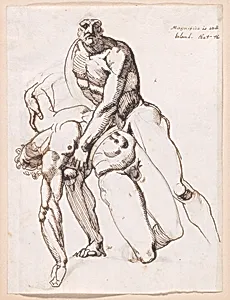
Menelaus and Patroclus, after the Antique (recto and verso)
1770–78
Medium
Pen and brown ink (recto); pen and ink over graphite (verso)
Dimensions
Sheet: 9 7/16 in. × 7 in. (24 × 17.8 cm)
Classification
Drawings
Department
Drawings and Prints
Museum
Metropolitan Museum of Art, New York, NY
Credit
Gift of Jacqueline Loewe Fowler, 2020
Accession Number
2021.16.30a, b
Rights
Public Domain
Tags
Art Historical Context
Henry Fuseli's *Menelaus and Patclus, after the Antique (recto and verso created between 1770 and 1778, captures a poignant moment from Greek mythology. On the recto, executed in pen and brown ink, the Swiss-born artist depicts the Trojan War hero Menelaus tenderly supporting the dying Patro, a comrade-in-arms whose death fueled Achilles' rage in Homer's *Iliad*. The verso, in pen and ink over graphite likely features a related study, showcasing Fuseli's meticulous process. This drawing, measuring just 9 7/16 × 7 inches, reflects the artist's deep engagement with classical antiquity during his formative years in Rome. As a pioneer of Romanticism, Fuseli infused neoclassical subjects with emotional intensity and dramatic musculature, elevating male nudes to symbols of heroic pathos. By working "after the Antique," he channeled renowned ancient sculptures like the Pasquino group, adapting their stoic forms into dynamic, expressive lines. The ink techniques—bold strokes on the recto and underdrawn graphite on the verso—highlight his mastery of contour and shadow, bridging precise draftsmanship with passionate interpretation. Housed in the Metropolitan Museum of Art's Drawings and Prints department through a 2020 gift, this intimate sheet invites visitors to ponder the enduring cultural resonance of mythic brotherhood and mortality, blending Fuseli's innovation with timeless heroism.
About the Artist
Henry Fuseli · 1741–1825
Henry Fuseli (1741-1825), born Johann Heinrich Füssli in Zürich, was a Swiss-British painter whose visionary works exploring dreams, nightmares, and psychological terror made him one of the most original figures of the Romantic movement. His art bridged Neoclassical discipline with Romantic emotionalism, creating images of supernatural intensity that would influence artists from William Blake to t...