
Mens Divinior
1895
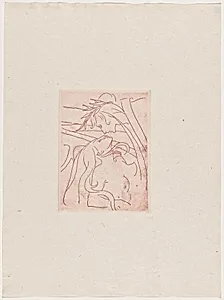
Medium
etching in red on china paper
Classification
Department
CG-E
Museum
National Gallery of Art, Washington, D.C.
Credit
Virginia and Ira Jackson Collection, gift in memory of Virginia H. Jackson
Accession Number
1996.151.209
Rights
Public Domain
Art Historical Context
**Mens Divinior** (1895) is a captivating etching by Belgian artist Émile Berchmans, master of late 19th-century printmaking known for his Symbolist leanings. Created during the fin-de-siècle era, when artists explored mysticism and the spiritual realm, the title—Latin for "More Divine Mind"—evokes themes of elevated intellect and transcendence, aligning with Belgium's vibrant Symbolist movement alongside figures like James Ensor and Fernand Khnopff. This work stands out for its innovative medium: an etching in red ink (often called *rouges*) on delicate china paper, a thin, luxurious Asian-imported sheet prized for its absorbency and ability to capture intricate details with exceptional clarity. Etching, an intaglio technique involving acid-bitten plates, allowed Berchmans to achieve fine lines and tonal subtleties, making each impression a testament to the printer's craft. The red hue adds a dramatic, almost alchemical warmth, enhancing the print's ethereal quality. Housed in the National Gallery of Art's Department of Prints (CG-E), *Mens Divinior* entered the collection as a gift from the Virginia and Ira Jackson Collection in memory of Virginia H. Jackson. It exemplifies how prints democratized art while preserving elite techniques, inviting visitors to ponder the divine spark in human creativity. (198 words)
About the Artist
Emile Berchmans · 1867–1947
Émile Berchmans (1867-1947) was a Belgian painter and one of the most important Belgian poster artists of the early twentieth century, playing a crucial role in the development of Art Nouveau graphic design in Liège. Born into an artistic dynasty—his father Émile-Édouard Berchmans was an accomplished painter and his brother Oscar a talented sculptor—Émile the Younger (as he was sometimes known) de...