
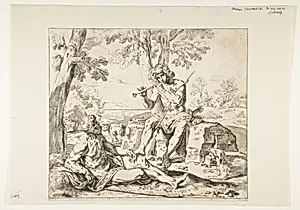
Mercury and Argus, copy in reverse after Cantarini
ca. 1630–1648 or after
Medium
Etching
Dimensions
Sheet: 10 1/4 × 11 13/16 in. (26.1 × 30 cm)
Classification
Prints
Department
Drawings and Prints
Museum
Metropolitan Museum of Art, New York, NY
Credit
The Elisha Whittelsey Collection, The Elisha Whittelsey Fund, 1951
Accession Number
51.501.3261
Rights
Public Domain
Tags
Art Historical Context
Behold *Mercury and Argus, copy in reverse after Cantarini an exquisite etching by Simone Cantarini dating to around 1630–1648 or later. This print captures a pivotal moment from classical mythology, drawn from Ovid's *amorphoses*. The swift-footed god Mercury employs his syrinx (panpipes)—a musical instrument crafted from reeds—to lull the hundred-eyed giant Argus to sleep, fulfilling Zeus's command to slay the watchful guardian and free the nymph Io. Surrounding them are men, dogs, and trees, evoking a lush, narrative landscape that heightens the drama. Cantalini, a Bolognese artist influenced by the Caravaggesque style and masters like Guido Reni, excelled in etching, a precise intaglio technique where acid bites into a metal plate to create intricate lines. This "copy in reverse" suggests a mirrored reproduction, likely facilitating transfer or artistic study, showcasing the era's fascination with printmaking for disseminating grand compositions. Measuring 10 1/4 × 11 13/16 inches, its scale invites close inspection of delicate details, from Mercury's flowing drapery to Argus's vigilant form. Housed in the Metropolitan Museum of Art's Drawings and Prints department, thanks to The Elisha Whittelsey Collection, this work exemplifies 17th-century Baroque interest in dynamic storytelling and humanism. It bridges painting and print, making mythological grandeur accessible to collectors and scholars alike.
About the Artist
Simone Cantarini · 1612–1648
He was one of the most eminent pupils of Guido Reni and one of the most gifted engravers in the tradition of the Carracci. He had a strong personality and developed a highly original style, which united aspects of Bolognese classicism with a bold naturalism. Comment on works: Religious