
Mercury and Cupid
late 1630s
Medium
Bronze
Dimensions
Height confirmed: 31 in. (78.7 cm)
Classification
Sculpture-Bronze
Culture
British, London
Department
European Sculpture and Decorative Arts
Museum
Metropolitan Museum of Art, New York, NY
Credit
Gift of The Quentin Foundation, 2021
Accession Number
2021.76
Rights
Public Domain
Tags
About this artwork
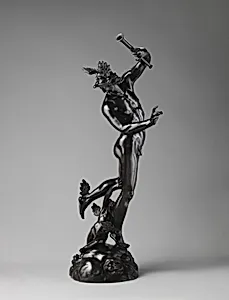
Mercury and Cupid depicts the dramatic moment when the messenger god ascends skyward to announce that Psyche must return to Venus. Three puffy-cheeked wind gods gust Mercury upward, while a tiny infant Cupid squirming on the cloud desperately grabs at Mercury's legs, attempting to thwart the liftoff and earning only Mercury's amused backward glance. Francesco Fanelli created this dynamic bronze sculpture in London during the late 1630s, working for the court of Charles I. The composition exempli...
Art Historical Context
**Mercury and Cupid** by Francesco Fanelli captures a whirlwind moment from classical mythology: the swift messenger god Mercury soaring skyward, propelled by puffing wind gods, as a frantic infant Cupid clings to his legs in a desperate bid to stop him. Created in London during the late 1630s, this dynamic bronze sculpture—standing nearly three feet tall (31 in., 78.7 cm)—was crafted for the court of King Charles I. Fanelli, an Italian artist who introduced vibrant Baroque aesthetics to England, how Continental influences enriched British art just before the Civil War disrupted royal patronage in 1642. The work's spiraling composition masterfully conveys Baroque drama, with sweeping forms and emotional tension designed to energize grand public spaces. Cast in sections via the intricate lost-wax method, the bronze showcases Fanelli's technical prowess, its lustrous black patina remarkably preserved alongside all original elements. This exceptional survival highlights the sculpture's role in popularizing elaborate bronze groups at the English court, blending myth, movement, and majesty for viewers entranced by its lifelike energy. A gift to the Metropolitan Museum of Art from The Quentin Foundation in 2021, it invites us to ponder the fleeting joys and rivalries of the gods.