
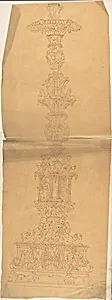
Metal Candlestick with Classical Ornament
19th century
Medium
Pen and brown ink on tracing paper
Dimensions
sheet: 20 1/16 x 7 5/16 in. (51 x 18.5 cm)
Classification
Drawings|Ornament & Architecture
Department
Drawings and Prints
Museum
Metropolitan Museum of Art, New York, NY
Credit
The Elisha Whittelsey Collection, The Elisha Whittelsey Fund, 1960
Accession Number
60.632.156
Rights
Public Domain
Tags
Art Historical Context
This delicate drawing, titled *Metal Candlestick with Classical Or*, captures the elegance of 19th-century British design by an anonymous artist. Rendered in pen and brown ink on paper—a medium favored for its translucency, allowing draftsmen to trace and refine motifs from classical sources—the sheet measures 20 1/16 x 7 5/16 inches. It depicts a ornate candlestick adorned with neoclassical elements like acanthus leaves, scrolls, and urns, evoking the grandeur of ancient Greece and Rome. In Victorian Britain, such ornamental drawings were essential tools for artisans crafting metalwork, bridging architecture and decorative arts. The classical revival, inspired by archaeological discoveries, influenced everything from furniture to silverware, symbolizing refinement and national pride amid the Industrial Revolution. This piece reflects the meticulous precision required in workshops, where designs were scaled, copied, and adapted for production. Housed in the Metropolitan Museum of Art's Drawings and Prints department as part of The Elisha Whittelsey Collection (acquired 1960), it offers a window into the unsung craft of pattern-making. Visitors can appreciate how these humble sketches fueled the opulent interiors of the era, blending functionality with timeless beauty.
About the Artist
Anonymous, British, 19th century · 1800–1900
**Anonymous, British, 19th century** is not the name of a single individual but a standard museum attribution used for works whose creators remain unidentified yet are clearly British and date to the 1800s. Major institutions, including the Metropolitan Museum of Art, employ this designation for hundreds of drawings, prints, designs, and decorative studies that lack signatures or firm documentary ...