
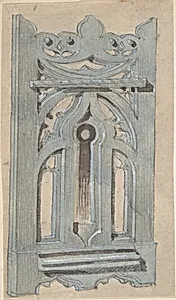
Metal Keyplate for Church
second half 19th century
Medium
Gouache
Dimensions
sheet: 3 3/4 x 2 5/16 in. (9.6 x 5.8 cm)
Classification
Drawings|Ornament & Architecture
Department
Drawings and Prints
Museum
Metropolitan Museum of Art, New York, NY
Credit
The Elisha Whittelsey Collection, The Elisha Whittelsey Fund, 1960
Accession Number
60.632.148(1)
Rights
Public Domain
Art Historical Context
This delicate gouache drawing, titledMetal Keyplate for Church offers a glimpse into 19th-century British ecclesiastical design. Created anonymously in the second half of the century, it a finely wrought metal keyplate—likely an escutcheon or door fitting for a church door. Measuring just 3 3/4 x 2 5/16 inches, its intimate scale suggests it served as a precise preparatory study for a metalworker or architect, preserved in The Metropolitan Museum of Art's Elisha Whittelsey Collection. Gouache, an opaque watercolor medium prized for its vibrant colors and smooth finish, was ideal for rendering intricate metal textures and ornamental details. The technique allowed the anonymous artist to simulate the gleam of polished metal, foliate motifs, and Gothic-inspired flourishes common in Victorian church architecture. During this era, Britain's Gothic Revival movement revived medieval styles for religious buildings, emphasizing ornate hardware as symbols of reverence and craftsmanship. As part of the Drawings and Prints department's Ornament & Architecture classification, this work highlights the unsung role of anonymous designers in shaping everyday sacred spaces. It invites us to appreciate the meticulous planning behind functional beauty, bridging art and utility in 19th-century worship.
About the Artist
Anonymous, British, 19th century · 1800–1900
**Anonymous, British, 19th century** is not the name of a single individual but a standard museum attribution used for works whose creators remain unidentified yet are clearly British and date to the 1800s. Major institutions, including the Metropolitan Museum of Art, employ this designation for hundreds of drawings, prints, designs, and decorative studies that lack signatures or firm documentary ...