
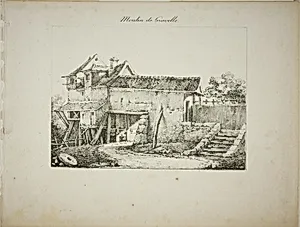
Mill at Gravelle, II
Medium
Lithograph in black on ivory laid paper
Dimensions
Image: 13.5 × 18.5 cm (5 3/8 × 7 5/16 in.); Sheet: 21.7 × 28.4 cm (8 9/16 × 11 3/16 in.)
Classification
lithograph
Department
Prints and Drawings
Museum
Art Institute of Chicago
Accession Number
41730
Rights
Public Domain
Art Historical Context
**Mill at Gravelle, II** is a delicate lithograph by French artist Louis Jules Frederic Vill, created between 1824 and 1827. This intimate print captures a serene landscape scene featuring a mill at Gravelle, likely a quiet riverside spot near Paris, rendered in crisp black ink on creamy ivory laid paper. Measuring just 13.5 × 18.5 cm for the image, its modest scale invites close viewing, evoking the everyday beauty of the French countryside during the Restoration period. Lithography, a revolutionary technique invented just decades earlier, allowed Villeneuve to draw directly onto a prepared stone with greasy crayon, producing multiples that mimicked the fluidity of pencil sketches. This early adoption highlights the medium's rise in the 1820s as an accessible alternative to costly engravings, democratizing art for a broader audience. The use of laid paper—distinguished by its subtle chain lines—adds a tactile authenticity typical of fine 19th-century prints. Housed in the Art Institute of Chicago's Prints and Drawings collection, *Mill at Gravelle, II* exemplifies the technical precision and atmospheric charm of proto-Romantic landscapes. It offers visitors a window into an era when industrial mills dotted idyllic scenes, blending human ingenuity with nature's quiet rhythm—a timeless nod to France's evolving artistic print culture.