
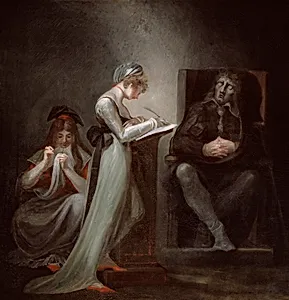
Milton Dictating to His Daughter
1794
Medium
Oil on canvas
Dimensions
121.2 × 118.7 cm (47 3/4 × 46 3/4 in.); Framed: 142.9 × 130.5 cm (56 1/4 × 51 3/8 in.)
Classification
oil on canvas
Department
Painting and Sculpture of Europe
Museum
Art Institute of Chicago
Accession Number
44739
Rights
Public Domain
About this artwork
This painting by Swiss artist Henry Fuseli depicts 17th-century English poet John Milton, who became blind in his 40s, dictating his epic poem Paradise Lost. His daughter transcribes his words while another woman listens intently as she sews. A forerunner of the Romantic Movement, Fuseli created drama through chromatic contrast. A cool light illuminates the rosy-cheeked women and casts deep shadows around Milton’s ghostly figure and face. Fuseli created this painting for his Milton Gallery, a se...
Art Historical Context
Henry Fuseli’s *Milton Dictating to His Daughter* (1794) captures a quiet yet powerful moment of literary creation. The Swiss-born artist, celebrated for his dramatic Romantic style fascination with literature, portrays the blind poet John Milton composing his epic *Paradise Lost*. Seated in shadow, Milton leans toward his daughter, whose attentive posture suggests both intimacy and intellectual partnership. The scene reflects the late-eighteenth-century fascination with genius, inspiration, and the heroic struggles of great writers. Painted in rich oil on canvas, Fuseli employs strong contrasts of light and darkness to heighten emotional tension—a hallmark of his work. Rather than heroic grandeur, he focuses on the domestic act of dictation, underscoring themes of resilience and familial devotion during Milton’s final years. Created amid growing European interest in Milton’s poetry, the painting invites viewers to consider how personal relationships sustain artistic achievement. Today in the Art Institute of Chicago’s collection, the work remains a compelling reminder of the human stories behind monumental literature.
About the Artist
Henry Fuseli · 1741–1825
Henry Fuseli (1741-1825), born Johann Heinrich Füssli in Zürich, was a Swiss-British painter whose visionary works exploring dreams, nightmares, and psychological terror made him one of the most original figures of the Romantic movement. His art bridged Neoclassical discipline with Romantic emotionalism, creating images of supernatural intensity that would influence artists from William Blake to t...