
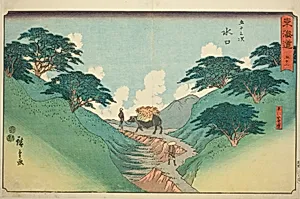
Minakuchi: The Beautiful Pine Trees at Mount Hiramatsu (Minakuchi, Hiramatsuyama bisho)—No. 51, from the series "Fifty-three Stations of the Tokaido (Tokaido gojusan tsugi)," also known as the Reisho Tokaido
c. 1847/52
Medium
Color woodblock print; oban
Dimensions
23.6 × 35.1 cm (9 1/4 × 13 13/16 in.)
Classification
woodblock print
Department
Arts of Asia
Museum
Art Institute of Chicago
Accession Number
25864
Rights
Public Domain
Art Historical Context
Utagawa Hirosh's *Minakuchi: The Pine Trees at Mount Hiram* (No. 51 from the series *Fifty-three of the Tōkaidō*, also known as the Reish Tōkaidō) captures the majestic landscape near the 51st station on the historic Tōkaidō road, a vital route connecting Edo (modern Tokyo) to Kyoto during Japan's Edo period (1603–1868). Created around 1847–52, this color woodblock print exemplifies Hiroshige's mastery ofkiyo-e, the "pictures of the floating world" genre that celebrated everyday beauty and transient nature. The Tōkaidō series, first published in 1833–34 with later editions like this Reisho version featuring elegant calligraphy, brought the thrill of travel to urban dwellers who rarely journeyed. Hiroshige's atmospheric style—evident in his subtle gradations of color (bokashi) and dynamic compositions—elevates humble post stations into poetic vistas, here highlighting the iconic pine trees of Mount Hiramatsu as symbols of enduring natural splendor. Printed in the standard oban format (23.6 × 35.1 cm), this accessible art form democratized landscape imagery through collaborative woodblock techniques, influencing global artists like Van Gogh. Housed in the Art Institute of Chicago's Arts of Asia collection, it invites us to savor the serene harmony of Japan's past.
About the Artist
Utagawa Hiroshige · 1826–1869
Utagawa Hiroshige (1797–1858), born Andō Tokutarō, was the last great master of Japanese ukiyo-e woodblock printmaking and one of the most influential landscape artists in history. Born in Edo (modern Tokyo) into a low-ranking samurai family serving as fire wardens, Hiroshige transformed landscape printmaking into a poetic meditation on nature, weather, and everyday life. His revolutionary approac...