
Minerva clock
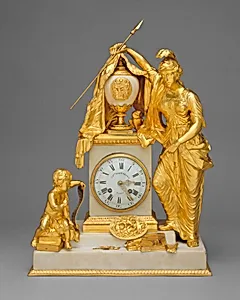
Medium
Gilt bronze, marble, enamel, brass, steel
Dimensions
Overall: 19 × 13 × 8 1/4 in. (48.3 × 33 × 21 cm)
Classification
Horology|Metalwork-Gilt Bronze
Culture
British
Department
European Sculpture and Decorative Arts
Museum
Metropolitan Museum of Art, New York, NY
Credit
Gift of Horace Wood Brock, in loving memory of his parents, Hope and Horace Brock, 1993
Accession Number
1993.489
Rights
Public Domain
Art Historical Context
Step into the opulent world of 18th-century decorative arts with the *Minerva Clock*, a stunning testament to British craftsmanship around 1770. Crafted by a collaborative team including British industrialist Matthew Boulton French clockmakers Henri-Charles Louis-Charles Baltazard enamel specialist Theodore Rodel, and the firm Vincenti et Cie this timepiece embodies the era's international exchange of expertise. Housed in the Metropolitan Museum of Art's Sculpture and Decorative Arts collection, it measures a compact 19 × 13 × 8¼ inches, perfect for a mantel or bureau in a gentleman's study. Fashioned from gilt bronze, marble, enamel, brass, and steel, the clock showcases masterful horology and metalwork. The shimmering ormolu (gilt bronze) case, likely fire-gilded for its radiant finish, highlights neoclassical motifs inspired by Roman goddess Minerva, symbolizing wisdom and the arts. Delicate enamel dials and intricate steel mechanisms reflect the technical prowess of the Enlightenment, when clocks evolved from mere tools to sculptural luxuries for the elite. This gift to the Met in 1993 celebrates not just precision engineering but the fusion of function and fantasy, evoking the intellectual salons of Georgian Britain. A true jewel of horology, it reminds us how timepieces like this captured the spirit of discovery and refinement.
About the Artist
Theodore Rodel|Vincenti et Cie|Matthew Boulton|Henri-Charles Baltazard|Louis-Charles Baltazard ( | |British| | ) · 1840 |1831 |1728 |1717 |1761 –1840 |1890 |1809 |1772 |1783
recorded 1840|1831–1890|British, Birmingham 1728–1809 Birmingham|recorded 1717–72|recorded 1761–83