
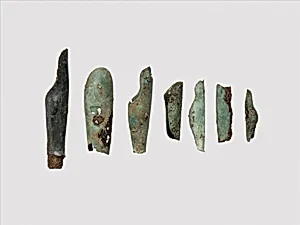
Miniature bronze greave
Unknown Artist
5th century BCE
Medium
Bronze
Dimensions
Other: 2 7/8 in. (7.3 cm)
Classification
Bronzes
Culture & Period
Etruscan · Classical
Department
Greek and Roman Art
Museum
Metropolitan Museum of Art, New York, NY
Credit
Rogers Fund, 1921
Accession Number
21.88.102
Rights
Public Domain
Art Historical Context
This exquisite miniature bronze greave, by an unknown Etruscan artist in the 5 century BCE, offers a glimpse into the martial world of ancient Italy's enigmatic Etruscan civilization. Measuring just 2 7/8 inches (7.3 cm), this tiny shin guard—part of a warrior's leg armor—exemplifies the Etruscans' mastery of bronze casting during their Classical period. Acquired through the Rogers Fund in 1921, it in the Metropolitan Museum of's Greek and Roman Art, among other remarkable bronzes. Etruscans, who flourished in central Italy from around 900 to 100 BCE, were heavily influenced by Greek artistry yet developed a distinctive style blending realism with ritualistic flair. Such miniature armors were likely votive offerings dedicated at sanctuaries, symbolizing protection in battle or gratitude to deities like Uni or Tinia. They reflect the Etruscans' warrior ethos and their role as intermediaries between Greek imports and emerging Roman culture. The piece's solid bronze construction highlights advanced lost-wax techniques, allowing intricate details despite its scale. As a cultural artifact, it underscores how Etruscans used art to navigate life's perils, inviting us to ponder the hopes of ancient soldiers in this pint-sized testament to resilience.