
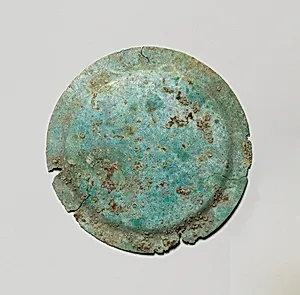
Miniature bronze shield
Unknown Artist
5th century BCE
Medium
Bronze
Dimensions
Diam.: 3 1/8 in. (7.9 cm)
Classification
Bronzes
Culture & Period
Etruscan, Vulci · Classical
Department
Greek and Roman Art
Museum
Metropolitan Museum of Art, New York, NY
Credit
Rogers Fund, 1921
Accession Number
21.88.110
Rights
Public Domain
Tags
Art Historical Context
This exquisite miniature bronze shield, crafted in the 5th century BCE by an unknown Etruscan artist from Vulci, offers a glimpse into the vibrant world of ancient Italy's most enigmatic civilization. Measuring just 3 1/8 inches in diameter, exemplifies the Etruscans' mastery of small-scale metalwork during their Classical period, a time when their city-states like Vulci thr as trade hubs and cultural powerhouses, influencing the emerging Romans. Bronze was a prized medium for Etruscans, often produced via sophisticated lost-wax casting techniques that allowed for intricate details on even tiny objects like this shield. Miniature shields such as this one were likely votive offerings dedicated in sanctuaries or tombs, symbolizing protection and martial prowess—key themes in Etruscan society, where warrior elites dominated. Its simple, functional form reflects both practical design and ritual significance, bridging everyday life with the divine. Today, housed in the Metropolitan Museum of Art's Greek and Roman Art Department (acquired through the Rogers Fund in 1921), this artifact invites us to ponder the Etruscans' lost legacy: a people whose art blended Greek influences with bold originality, leaving an indelible mark on Western history.